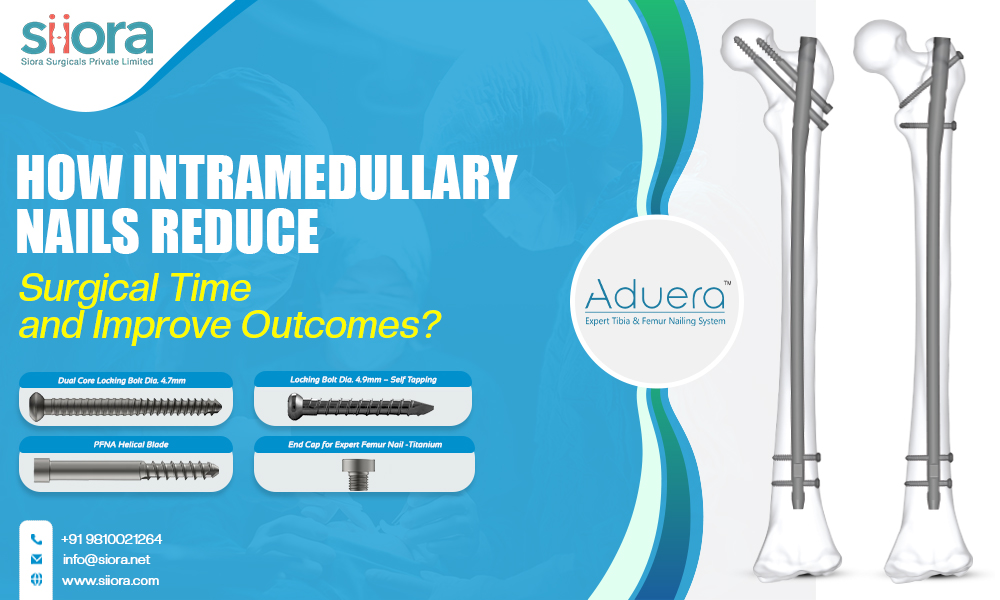
There’s a reason orthopedic surgeons keep coming back to intramedullary nails when treating long-bone fractures. Whether it’s the tibia, humerus, or femur, these implants have earned their place in modern trauma care. And if you’ve ever worked with an expert femur nail, you’ve probably noticed how the entire surgical process tends to run smoother—almost as if the implant naturally understands the bone’s internal architecture. That isn’t a coincidence. Intramedullary devices are built to make fixation faster, steadier, and more predictable.
Why They Work So Efficiently?
Intramedullary nails follow the path nature already created. Instead of fighting the bone from the outside, they use the medullary canal as a supportive track. This alone reduces the amount of soft-tissue disruption. Less disruption means surgeons spend less time opening, exposing, retracting, and adjusting. Everything is more direct.
And when procedures move more directly, they move faster.
In high-volume trauma centers, even a few minutes of reduced operating time can stack up to meaningful benefits—for the OR team, for the hospital, and most importantly, for the patient lying on the table.
Minimizing Soft-Tissue Impact
Traditional plating has its place, but it demands more exposure. Larger incisions. Wider dissections. Multiple points of screw insertion. Intramedullary nails, on the other hand, are inserted through a small entry point, usually just enough to align the guidewire and tap the canal.
That smaller footprint helps reduce bleeding and limits hidden trauma to the surrounding muscles. When the soft tissue is preserved, the bone often heals more predictably. Patients wake up with less soreness and recover mobility sooner. These are minor advantages at first glance, yet they shape the overall outcome in surprisingly significant ways.
Stability That Supports Faster Healing
A well-positioned intramedullary nail acts like an internal scaffold. Instead of sitting on the bone’s surface, it becomes part of its internal column. This makes load-sharing more natural and allows early mobilization—a key factor in preventing complications such as joint stiffness, muscle wasting, or deep vein thrombosis.
Some surgeons point out how intuitive the fixation feels. Once locked proximally and distally, the nail gives the fracture a steady, predictable environment. With a femoral nail, for instance, the alignment tends to stay where you put it. You aren’t fighting the fracture line the way you sometimes do with an external or surface-level device.
A Technique That Saves Time Without Cutting Corners
Every surgeon knows that “quick” is never the goal in trauma surgery—efficient is. Intramedullary nailing manages to combine the two. The process is streamlined: ream, insert, lock, confirm. Over time, as operating teams become familiar with a specific nail system, the flow becomes even more natural.
Another often-overlooked advantage is fluoroscopic predictability. When the entry point is established properly and the canal is prepared well, the nail glides down without constant repositioning. That alone can shave off several minutes of intraoperative adjustments.
Better Outcomes That Go Beyond the OR
When surgical time drops and soft-tissue damage is minimized, the recovery curve shifts. Patients tend to bear weight earlier, regain function faster, and avoid prolonged immobilization. This combination is particularly important in elderly patients, who face greater risks with long surgeries and extended downtime.
Intramedullary nails also lower the chances of implant failure, malalignment, or repeat procedures—factors that heavily influence long-term outcomes.
The Bottom Line
What began as a technique focused on stabilizing fractures has evolved into one of the most efficient, outcome-driven treatments in orthopedic trauma. Today’s nails—whether used in the tibia, humerus, or femur—bring together stability, biology, and surgical efficiency in a way few orthopaedic implants can match. And when the surgeon finishes the case with a stable construct, minimal soft-tissue disturbance, and less time spent under anesthesia, patients feel the difference throughout their entire recovery.
That’s why intramedullary nailing continues to remain a cornerstone in fracture fixation, and why even the last finishing steps—like locking a femur interlocking nail—play a big part in driving better, safer outcomes.
 Ortho Implants Company